What Is Multi-Tenant Email Sending?
By MailChannels | 12 minute read

Multi-tenant email sending is the operation of sending email for multiple independent customers, users, workspaces, or software agents through a common platform. Because the platform does not fully control every message, recipient, or sending pattern, it needs controls that attribute activity and risk to the tenant responsible for it.
The core distinction: who controls the sending?
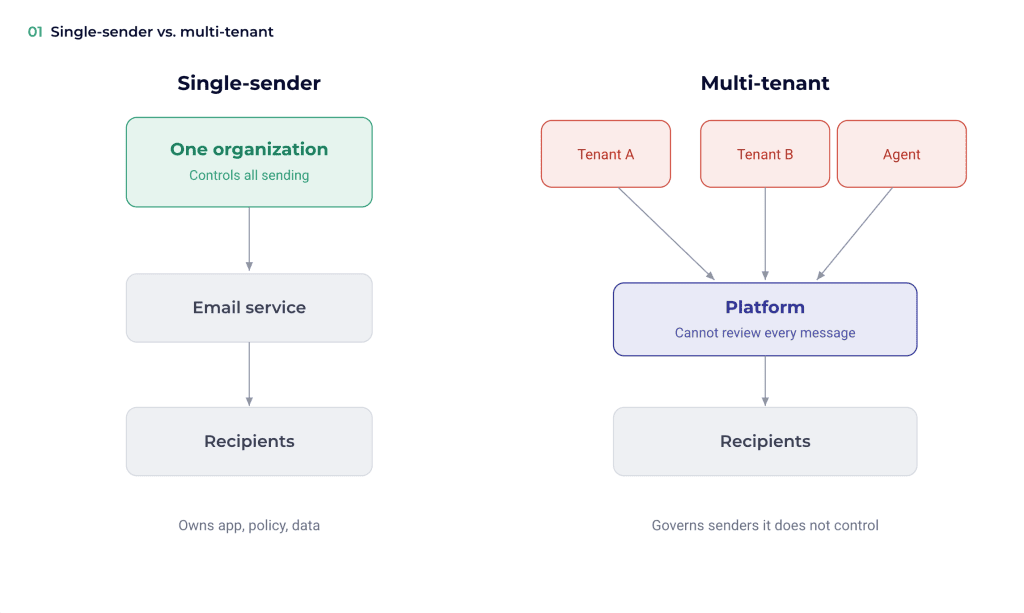
In a conventional single-sender deployment, one organization uses an email service provider to send its own password resets, receipts, notifications, newsletters, or other messages. That organization controls the application, the sending policy, and the recipient data.
In a multi-tenant deployment, the platform sends on behalf of many independent parties. Those parties may be customers, workspaces, users, hosted websites, automated workflows, or AI agents. The platform can impose rules, but it usually cannot review every message or fully predict each tenant’s behaviour.
Multi-tenant email infrastructure is therefore designed to associate each message with a tenant and to apply limits, authentication, feedback, monitoring, and enforcement at that level. The objective is to reduce the chance that one tenant’s behaviour will impair service for everyone else. Complete isolation is rarely possible, because mailbox providers and email service providers can evaluate related domains, authentication records, sending accounts, content, traffic patterns, and infrastructure in addition to individual IP addresses.
Why multi-tenant sending is harder than single-sender email
Shared reputation and account risk
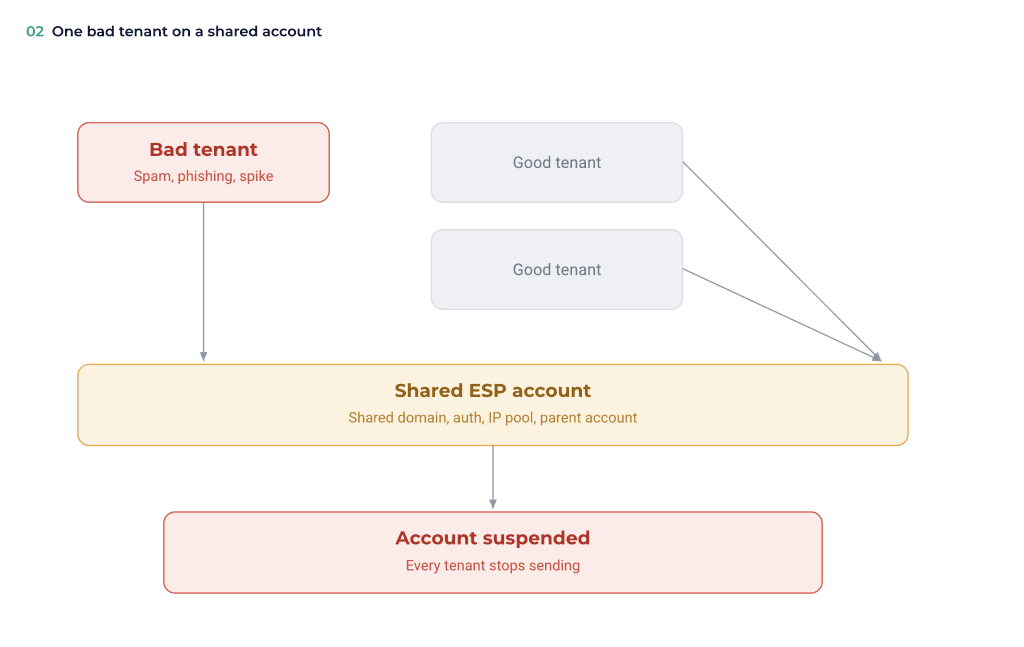
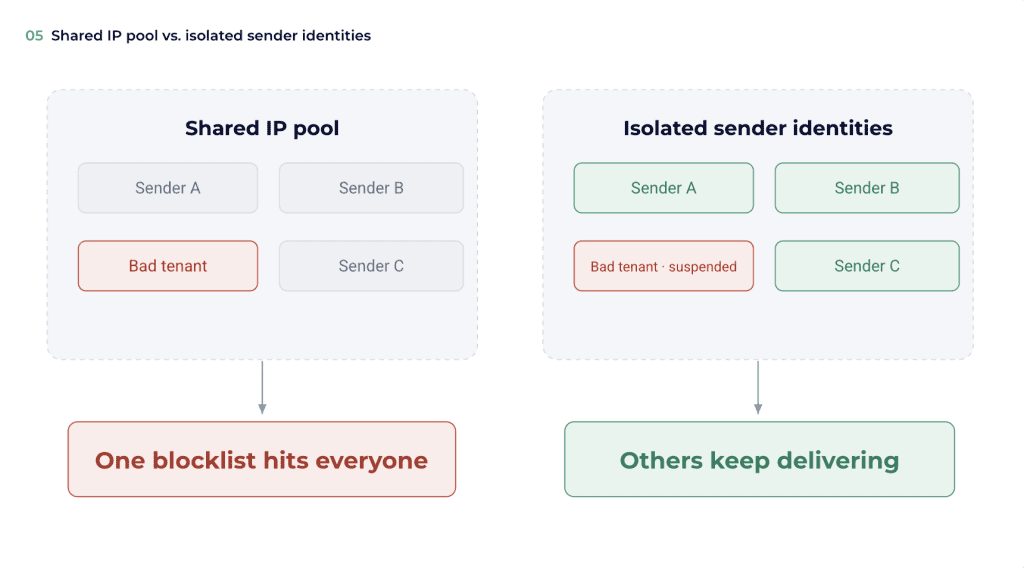
When tenants share a domain, authentication configuration, IP pool, or parent email-service account, one tenant’s spam complaints, hard bounces, phishing activity, or sudden volume increase can affect the others. Mailbox providers may throttle or block related traffic, and the email service provider may restrict or suspend the parent account.
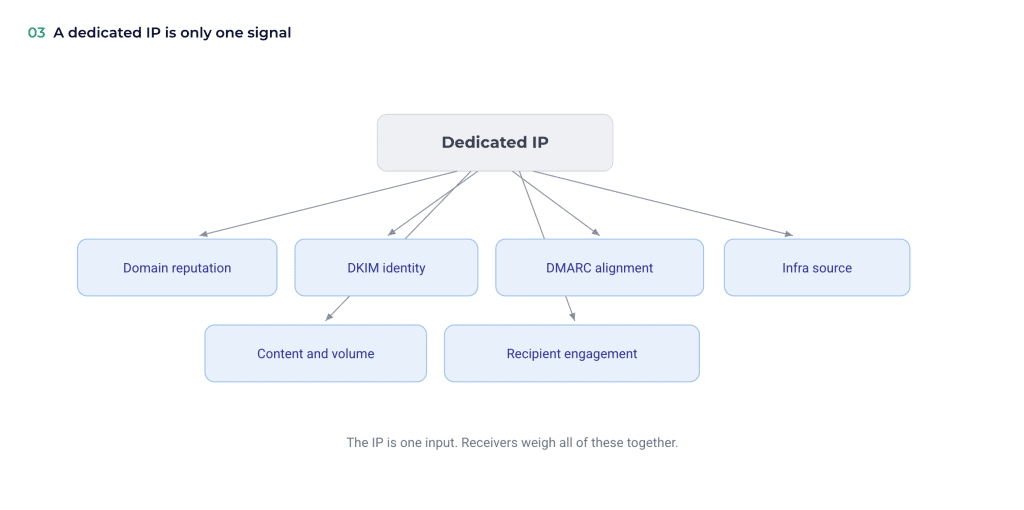
A dedicated IP can reduce one form of shared risk, but it is not a complete isolation mechanism. Receiving systems also evaluate domain reputation, DKIM identity, DMARC alignment, message content, recipient engagement, and relationships between sending resources. A tenant with a dedicated IP can therefore still create risk for the platform’s domains or service-provider account.
Limited visibility into individual senders
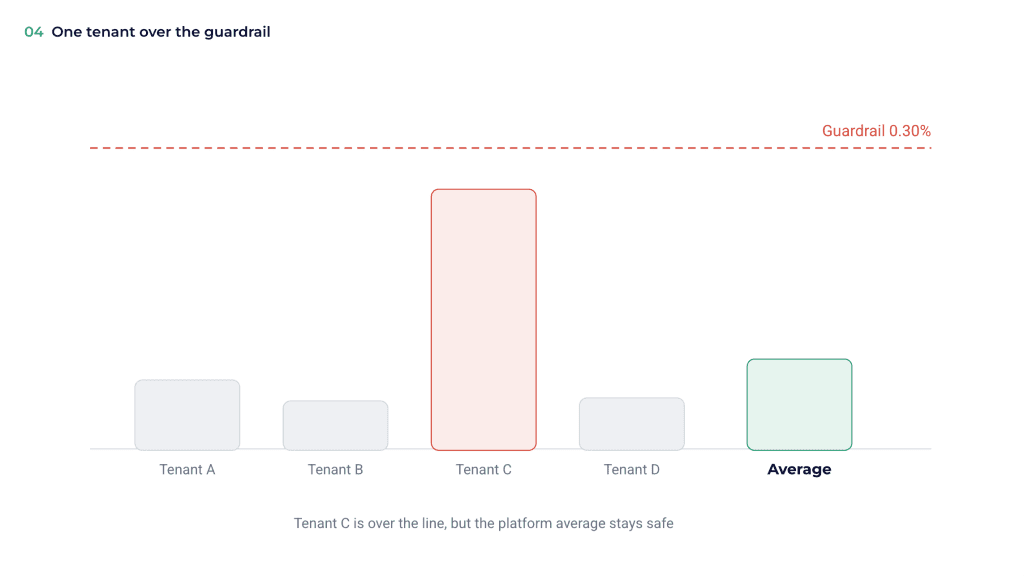
Aggregate metrics can hide a concentrated problem. A platform-wide complaint rate may appear acceptable even when one tenant has a severe complaint rate. The same is true of hard bounces, blocked messages, unusual sending volume, and spam detections.
Google advises senders to keep the user-reported spam rate shown in Postmaster Tools below 0.10% and to avoid reaching 0.30% or higher. [1] These figures should be treated as operational guardrails rather than universal cutoffs for every mailbox provider.
There is no universal mailbox-provider bounce-rate limit. As an operational benchmark, however, total bounce rates below approximately 2% are generally considered normal; rates between 2% and 5% warrant investigation, and rates above 5% are serious. [3] Permanent failures should normally be suppressed after the first confirmed hard bounce.
Behaviour cannot be fully screened in advance
A legitimate customer account can be compromised. A previously well-behaved user can import poor-quality recipient data. An automation can enter a loop. An AI agent can misinterpret an instruction or be manipulated into sending messages the operator did not intend.
Signup screening is therefore only one control. A multi-tenant system also needs continuous monitoring, rate limits, complaint and bounce processing, and a way to stop a tenant while leaving other tenants operational.
Enforcement must be tenant-specific
If the platform’s only control is an account-wide kill switch, it must choose between allowing harmful traffic to continue and interrupting every tenant. Per-tenant throttling and suspension reduce that blast radius.
Support investigations become more complex
Without tenant-level logs and metrics, a support team cannot readily determine whether a delivery problem is caused by the customer’s authentication, recipient data, content, complaint history, rate limits, or a broader infrastructure issue. Each incident becomes a manual investigation across several systems.
Components of multi-tenant email infrastructure

Tenant identification
Every send should carry an immutable tenant identifier. The identifier should be present in the platform’s request context, message metadata, delivery events, complaint and bounce records, audit logs, and enforcement decisions.
Sender identity and authentication
A tenant’s sender identity may include a sending domain or subdomain, DKIM keys, DMARC alignment, envelope-sender configuration, visible From addresses, and an email-service subaccount or tenant object. Some high-volume tenants may also require separate IP resources.
The appropriate boundary depends on volume, risk, customer requirements, and the capabilities of the email service provider. Assigning every tenant a dedicated IP is neither necessary nor sufficient in all cases.
Per-tenant rate limits
Limits should be applied independently to each tenant. Useful dimensions include messages per minute, hour, and day; recipient count; concurrent jobs; recipient-domain concentration; and sudden deviation from historical volume.
New or unverified tenants should usually begin with conservative limits. Limits can be adjusted as the tenant establishes a consistent sending history and a legitimate business need.
Complaint and bounce processing
Delivery failures and complaints must be mapped back to the tenant that caused them. Mailbox providers expose this information in different ways: some offer message-level complaint feedback, while Gmail generally provides aggregate domain-level spam-rate information through Postmaster Tools.
A platform should maintain tenant-level suppression records, immediately suppress confirmed hard bounces, distinguish temporary from permanent failures, and monitor complaint and bounce trends over an appropriate sample size.
Tenant-specific enforcement
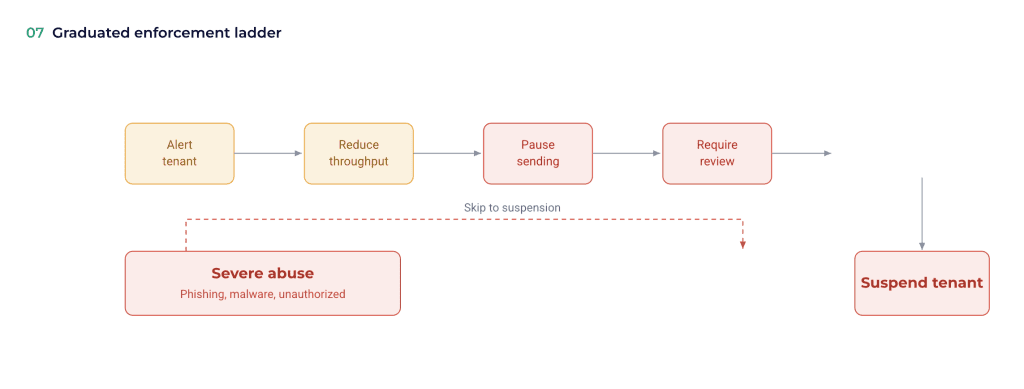
Enforcement should be graduated where practical. A typical sequence is: alert the tenant, reduce throughput, pause sending, require review, and suspend the tenant if the problem continues. Severe phishing, malware, or clearly unauthorized sending may justify immediate suspension.
Policy controls
Depending on the product, policies may cover allowed message types, recipient sources, attachment types, sender domains, maximum recipient counts, sending hours, approval requirements, and restrictions on unsolicited or bulk email.
Observability
The operator should be able to inspect, at minimum:
- Messages accepted, rejected, deferred, and delivered by tenant
- Hard- and soft-bounce rates by tenant
- Complaint and unsubscribe rates where applicable
- Sending volume and rate-limit events
- Suppression-list activity
- Domain-authentication status
- Policy decisions and suspension history
- Message and event identifiers needed for support investigations
Audit trails
For security, customer support, and compliance purposes, the platform should retain an appropriate record of who initiated a send, which tenant was responsible, what policy was applied, when the message was processed, and what delivery outcome was reported. Retention should be limited to what is necessary and consistent with the platform’s privacy obligations.
Who uses multi-tenant email infrastructure?
Common examples include:
- SaaS platforms whose customers send invoices, confirmations, ticket updates, alerts, or other operational messages.
- Automation platforms where customer-created workflows can trigger email.
- AI-agent platforms where agents send messages on behalf of users or organizations.
- Web-hosting providers whose customers run websites, applications, or scripts that generate outbound mail.
- Vertical software products in areas such as property management, healthcare administration, legal services, recruiting, and field services.
Use cases this article does not address
A company sending only its own transactional or marketing email does not ordinarily need a tenant-governance layer. It may still need sound deliverability practices, but it is not governing an independent sender population.
Cold-outreach and unsolicited bulk-email platforms can also be multi-tenant, but they present different consent, legal, policy, and deliverability risks. This article is not a guide to operating those services.
Reported operational outcomes
MailChannels publishes customer case studies reporting substantial reductions in email-delivery support tickets after hosting providers adopted its outbound filtering service. Its DreamHost page describes a reduction of approximately 97%, while its Rebel.com case study reports an immediate 90% reduction. [6] [7]
These are vendor-published customer stories, not controlled or independently audited studies. They support the narrower conclusion that better abuse detection, sender attribution, and support tooling can reduce operational workload in some hosting environments. They should not be treated as guaranteed outcomes for every SaaS platform.
Multi-tenant sending and AI agents
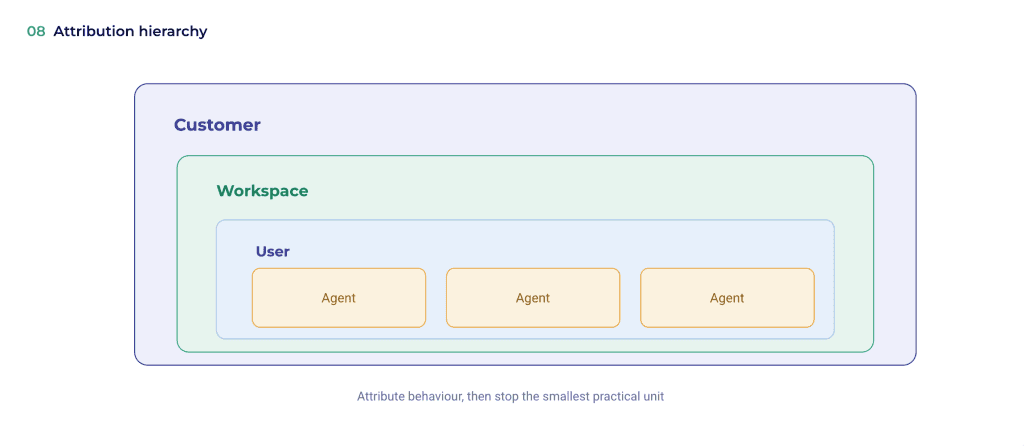
An email-capable agent is another source of independently initiated traffic. It may act at machine speed, operate without review of every message, and respond to untrusted input. Those characteristics make rate limits, approval policies, audit records, and rapid suspension especially important.
The correct isolation unit is not necessarily one identity for every individual agent process. Depending on the product, controls may be attached to the customer, workspace, user, agent, campaign, or a combination of those entities. The important requirement is that the operator can attribute behaviour and stop the smallest practical unit responsible for it.
How multi-tenant infrastructure differs from a general-purpose email API
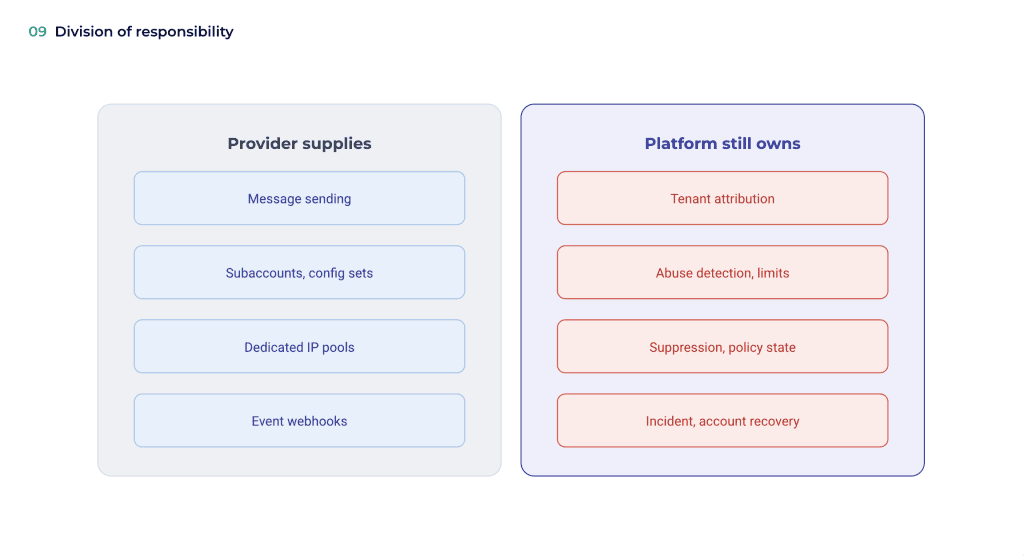
General-purpose email service providers can be used for multi-tenant sending. Some offer subaccounts, tenant-management features, configuration sets, dedicated IP pools, event webhooks, and account-level controls. Amazon SES, for example, provides tenant-management functionality intended to help isolate reputation and deliverability. [2]
The distinction is therefore not simply “generic API” versus “multi-tenant API.” The relevant question is whether the complete system provides the tenant attribution, reputation boundaries, policy controls, monitoring, feedback processing, enforcement, and operational support the platform requires.
When a platform builds on a general-purpose provider, it will usually remain responsible for significant parts of tenant governance, including:
- Mapping every message and event to a tenant
- Evaluating abuse and anomalous behaviour
- Setting and enforcing tenant-specific limits
- Maintaining suppression and policy state
- Responding to blocklist or reputation incidents
- Handling appeals, false positives, and account recovery
- Understanding how one tenant can affect the parent account
Summary
Multi-tenant email sending supports many independent senders through a common platform. Its central engineering problem is not merely message delivery; it is controlling the risk created by senders whose behaviour the platform cannot fully predict.
A credible multi-tenant design generally includes:
- Reliable tenant attribution for every message and delivery event
- Sender-domain and authentication controls
- Per-tenant rate limits and policy enforcement
- Complaint, bounce, and suppression handling
- Tenant-specific throttling and suspension
- Per-tenant observability and audit trails
- An operational process for abuse and reputation incidents
Additional IP addresses alone do not provide these capabilities. Conversely, a general-purpose email API is not automatically unsuitable: it can be part of a multi-tenant design when the platform supplies the missing governance and operational layers.
Frequently asked questions
What is the difference between multi-tenant and single-sender email?
In a single-sender deployment, one organization controls the messages and recipient data associated with the email-service account. In a multi-tenant deployment, the platform sends on behalf of independent customers, users, workspaces, or agents and must govern their behaviour separately.
Can I use Amazon SES, SendGrid, Mailgun, or Postmark?
Yes. The question is whether the provider’s controls, combined with your own application and operations, satisfy the platform’s requirements. A subaccount or dedicated IP may be useful, but neither automatically supplies complete tenant attribution, abuse detection, policy enforcement, or protection from parent-account suspension.
What is a tenant sender identity?
It is the collection of identifiers and configuration associated with a tenant’s sending. Depending on the architecture, it can include a sending domain or subdomain, DKIM keys, envelope sender, DMARC alignment, service-provider tenant or subaccount, policy profile, and assigned IP resources.
What causes blocklisting in a shared platform?
Blocklists and receiving systems can react to evidence such as spam, phishing, compromised accounts, spam-trap traffic, unusual volume, or persistent policy violations. Spamhaus, for example, lists IP resources associated with spam and other abusive activity. [4]
A blocklist is only one possible consequence. Mailbox providers may also defer or reject messages based on their own reputation systems, and an email service provider may restrict the platform’s account.
What complaint rate should concern a platform?
Google recommends keeping the spam rate reported in Postmaster Tools below 0.10% and avoiding 0.30% or higher. [1] A platform should investigate a tenant before it reaches those figures, while accounting for sample size, message type, and the way each provider calculates complaints.
What bounce rate should concern a platform?
A hard-bounce rate above approximately 2% is a useful warning benchmark, not a universal provider rule. Rates between 2% and 5% should be investigated, while rates above 5% indicate a serious list-quality, configuration, or abuse problem. [3]
What is per-tenant suspension?
Per-tenant suspension is the ability to stop or pause one tenant’s outbound email without stopping unrelated tenants. It depends on reliable tenant attribution and enforcement points in both the platform and its email infrastructure.
What does “abuse operations” mean?
Abuse operations is the continuing work of identifying compromised or malicious senders, reviewing unusual traffic, responding to complaints, enforcing policies, managing reputation incidents, handling false positives, and restoring legitimate senders after remediation.
Do AI agents require multi-tenant controls?
They do when independent users or customers can cause agents to send email through a common platform. The controls may be attached to the agent, user, workspace, or customer, but the platform must be able to attribute the traffic, limit it, audit it, and stop the responsible unit.
How does MailChannels position itself for multi-tenant use cases?
MailChannels markets its service as a managed email and abuse-operations layer for hosting providers and platforms. It states that its outbound service processes more than 100 million messages per day and is used by 25% of the top 100 hosting providers. [5] These figures are vendor-reported.
A platform evaluating MailChannels or any other provider should verify the current product documentation and contract terms, including tenant identity semantics, event attribution, suspension behaviour, parent-account risk, data retention, service levels, and responsibility for incident response.
References
- Google, “Email sender guidelines.” https://support.google.com/a/answer/81126
- Amazon Web Services, “Improve email deliverability with tenant management in Amazon SES.” https://aws.amazon.com/blogs/messaging-and-targeting/improve-email-deliverability-with-tenant-management-in-amazon-ses/
- Mailtrap, “What Is Email Bounce Rate and Why Is It Important?” https://mailtrap.io/blog/email-bounce-rate/
- Spamhaus, “Spamhaus Blocklist.” https://www.spamhaus.org/blocklists/spamhaus-blocklist/
- MailChannels, “Outbound Spam Filtering for Hosting Providers.” https://www.mailchannels.com/outbound/
- MailChannels, “DreamHost Success Story.” https://www.mailchannels.com/dreamhost-success-story/
- MailChannels, “Rebel.com Cuts Support Tickets Related to Email Delivery by 90%.” https://www.mailchannels.com/customer/rebel-com/